Showing posts with label Going Green. Show all posts

Earth Day 2012

Sunday, April 22, 2012


Happy Earth Day!  
I love infographics and the one below from Recyclebank is perfect for today!

Share Responsibility for the Planet
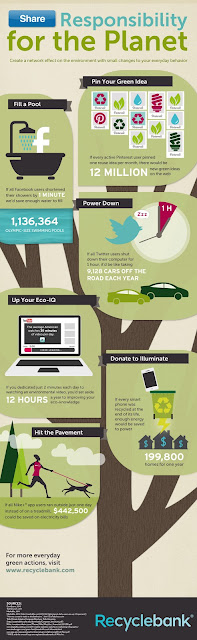
Create a network effect on the environment with small changes to your everyday behavior -- Let's take going green viral!
  • Fill a Pool: If all Facebook users shortened their showers by 1 minute we'd save enough water to fill 1,123,364 Olympic-sized swimming pools  
  • Pin Your Green Idea: If every active Pinterest user pinned one reuse idea per month, there would be 12 million new green ideas on the web
  • Power Down: If all Twitter users shut down their computers for one hour, it'd be like taking 9,128 cars off the road for a  year
  • Up your Eco-IQ: If you set aside just two minutes a day to watching an environmental video, you'd set aside 12 hours a year to improve your eco-knowledge
  • Donate to Illuminate: If every smart phone was recycled at the end of its life, enough energy would be saved to power 199,800 homes for one year.
  • Hit the Pavement: If all Nike+ app users ran outside for just one day instead of on a treadmill $442,500 could be saved on electricity bills.  

Share Responsibility for the Planet Infographic


Klean Kanteen

Sunday, April 1, 2012


I just ordered two of these Klean Kanteen Sets for my girls to replace all of our plastic sippy cups.  I am so tired of trying to find the matching lids, straws, valves etc for all the different sippy cups we have. My girls fight over who gets what color, and I worry about toxic chemicals from the plastics leaching into their drinks or directly onto their skin.  I am hoping, once these arrive, to completely do away with all their other cups.  I know a lot of parents, who avoid plastics, give their little ones mason jars to drink from, but that would turn into a disaster at our house.  My kids can't seem to go ten feet without dropping their cups or sitting them down on something unstable like our white sofa.


I really love the Active Pink (above) and may get the adult version for myself if I like these bottles as much as I think I will.  My daughters chose the Solar Yellow and the Prevention Purple for themselves.
Klean Kanteen Solar YellowKlean Kanteen Prevention Purple

The sets we ordered come with both the sippy lids and the sport bottle caps, so they will grow with my girls.  Klean Kanteen has so many great colors and styles from which to choose. The ones pictured above are just a small sampling. The even do baby bottles. Plus, I really appreciated being able to purchase high quality, healthy, green products from a company that is truly devoted to doing what's best for their customers' health, their employees and suppliers, and our environment. 

FROM WWW.KLEANKANTEEN.COM HERE ARE THE OTHER FEATURES THAT HELPED ME DECIDE ON THESE PARTICULAR BOTTLES:
  • Free of BPA, phthalates and other toxins
  • 100% recyclable and eco-friendly
  • Made of 18/8, food-grade stainless steel, no liner needed
  • Doesn't retain or impart flavors
  • Slim design fits most bottle/cup holders
  • Rounded corners are easy to clean with no hard angles where dirt, germs or bacteria can stick
  • Stainless steel threads
  • Fits large ice cubes
  • Includes one Avent™ spout and dome lid
  • Cap & spouts are made of BPA-free polypropylene (pp#5)
  • Dishwasher safe (colored bottles should be hand-washed)
  • All parts can be boiled for sterilization
  • Capacity: 12 fluid ounces (355 ml)
  • Weight: 3.75 ounces (w/o cap)
  • Size: 5” H (w/o cap) x 2.75” W
  • Opening diameter: 1.75" (44 mm)

Are you using plastic sippy cups and bottles or greener, healthier alternatives? Are your kids' cups and bottles BPA and phthalate free? Are yours? Leave me a comment telling me what you're using and why.

Which Makes More Sense?

Tuesday, March 27, 2012

I love this chart.  I so often feel like individuals who put a lot of time, effort, and hard-earned income into making healthy, educated decisions and lifestyle choices are treated like they are crazy for not accepting the propaganda being pushed by big government and big business.
Double Click to View Larger 
Source: Occupy* Posters
So which make more sense to you? 
Regional environmental groups and community activists are spending their limited operating budgets in a massive conspiracy with 90% of the world's scientists to create a worldwide hoax and crash the global economy OR . . .
Big oil companies (and chemical companies like Monsanto, Dow, and DuPont) are spending their obscene profits to bribe anyone they can to protect their profits and limit any future liability their pollution may cause.  
Leave me a comment letting me know which makes more sense to you!

Environmental Benefits of Reduced Meat Consumption

Friday, January 13, 2012

Skip the Burger, Save the Earth :-)
Eating Less Meat Can Help Preserve Our Planet

REDUCE YOUR CARBON (AND METHANE) FOOTPRINT 
The United Nations’ Food and Agriculture Organization estimates that the meat industry generates 1/5 of the man-made greenhouse gas emissions that are accelerating climate change worldwide . . . far more than transportation. All livestock greatly contribute to CO2 emissions through their respiratory processes, but also of monumental concern is methane gas (CH4) emissions from their digestive processes. Methane gas is 21 times more effective at trapping heat in the atmosphere than carbon dioxide. With nearly 1.5 billion large ruminants like cows world-wide, both carbon dioxide and methane gas are being emitted into the atmosphere at astounding rates. These rates have been decreasing lately, but are still much higher than our Earth can continue to support, while remain a healthy environment for us.[1]

MINIMIZE WATER USAGE 
The water needs of livestock are tremendous, greatly exceeding those of vegetables or grains It takes 1,800 - 2,500 gallons of water to produce one pound of grain fed beef. With that same amount water, farmers could grow 16 pounds of broccoli, 25 pounds of potatoes, enough soybeans for three pounds of tofu or enough wheat for nearly five pounds of whole wheat bread.[2]

HELP REDUCE FOSSIL FUEL DEPENDENCE 
On average, about 40 calories of fossil fuel energy go into every calorie of feed lot beef in the U.S. Compare this to the 2.2 calories of fossil fuel energy needed to produce one calorie of plant-based protein. Moderating meat consumption is a great way to cut fossil fuel demand.[3]

PRESERVE THE RAIN FOREST  
Cattle ranching is the largest impetus behind the destruction of the Amazon Rain Forest with deforestation occurring at an alarming rate. From May 20000 to August 2006 alone, Brazil lost nearly 58,000 square miles of forest—an area larger than Greece.[4]


Learn More:
Meatless Monday
Health Benefits of Reduced Meat Consumption
Beef Consumption at 50 Year Low

Sources:
[1] http://www.fao.org/docrep/010/a0701e/a0701e00.HTM
[2] http://www.sierraclub.org/sustainable_consumption/toolkit/choosing.pdf
[3] http://www.meatlessmonday.com/why-meatless/
[4] http://www.mongabay.com/brazil.html

The Dirty Dozen for 2011

Tuesday, June 14, 2011

Is your produce coated in pesticide? The Environmental Working Group released their 2011 list today of the best and worst fruits and vegetables when it comes to pesticide contamination. You can use this list to spend your money for organic foods most effectively.  Print this list and take it to the supermarket with you!

"Eat your fruits and vegetables! The health benefits of a diet rich in fruits and vegetables outweigh the risks of pesticide exposure. Use EWG's Shopper's Guide to Pesticides to reduce your exposures as much as possible, but eating conventionally-grown produce is far better than not eating fruits and vegetables at all. The Shopper's Guide to Pesticide in Produce will help you determine which fruits and vegetables have the most pesticide residues and are the most important to buy organic. You can lower your pesticide intake substantially by avoiding the 12 most contaminated fruits and vegetables and eating the least contaminated produce."

EWG's 2011 Shopper's Guide to Pesticides in Produce

Dirty Dozen
Buy these organic
1
Apple
Apples
2
Celery
Celery
3
Strawberries
Strawberries
4
Peaches
Peaches
5
Spinach
Spinach
6
Nectarines
Nectarines
– imported
7
Grapes
Grapes – imported
8
Red Pepper
Sweet bell peppers
9
Potatoe
Potatoes
10
Blueberries
Blueberries
– domestic
11
Lettuce
Lettuce
12
Kale
Kale/collard greens
Clean 15
Lowest in Pesticide
1
Onions
Onions
2
Sweet Corn
Sweet Corn
3
Pineapple
Pineapples
4
Avocado
Avocado
5
Asparagus
Asparagus
6
Peas
Sweet peas
7
Mango
Mangoes
8
Eggplant
Eggplant
9
Cantelope
Cantaloupe
- domestic
10
Kiwi
Kiwi
11
Cabbage
Cabbage
12
Watermelon
Watermelon
13
Sweet Potatoes
Sweet potatoes
14
Grapefruit
Grapefruit
15
Mushrooms
Mushrooms

Why Wear Organic?

Wednesday, February 9, 2011

So I'm definitely guilty of buying organic and all-natural fibers when choosing clothing for my little ones, but not paying much attention when it comes to my own wardrobe. An article in a newsletter from one of my favorite bloggers EcoLogicalMom made me think twice about that this morning.  So much so that I wanted to share it with you right away: 

7 Reasons to Wear Organics
We all know that organic food is not treated with harmful pesticides, reason why it is delicious (and expensive!). However many of us don't fully understand the benefits of wearing organic clothing. Well, we've done a bit of a research for you, and here are the 7 key benefits of organic clothing you should know:

1. It is reported that cotton crops are the 2nd largest user of agricultural pesticides in the world. Only second to coffee internationally and to corn here in the United States. This means that 25% of the world's insecticides and 10% of the world's pesticides are dedicated to cotton. Four of the top nine pesticides used in treating  cotton is considered by the EPA to be highly carcinogenic. These are cyanide, dicofol, naled and propargite. Also, organic cotton is grown on land that is certified to be free from any pesticide, insecticide  and defoliants for at least three years. Also, organic fabric contains natural dyes, which are safer for your health and for the environment.

2. When the crops are sprayed it is estimated that only 25% of those chemicals actually get absorbed into the plant. The rest is drifting up to miles and settling on crops that we eat and into water that is a drinking source for humans and animals.

3. Some of the insects that these chemicals are supposed to repel are becoming immuned to these synthetics. This requires that more be dumped onto the plant in attempt to produce the highest yield possible.

4. Organic cotton is hypoallergenic, meaning it doesn't harbor the particles in the air that can make it hard to breathe.

5. Organic fabrics typically absorb moisture more efficiently than non-organic fabrics.

6. When you purchase organic fabric, you're supporting farmers who use products that are safer for the environment. Overall, buying organic cotton helps reduce your carbon footprint.

7. Because organic fabric isn't produced using harmful chemicals and pesticides, it is safer for the men and women who work the land. When you purchase organic fabric, you're supporting safer working environments.


Healthy Baby Bums!

Thursday, May 27, 2010

There's something so idyllic about cloth diapers hanging out to dry on a sunny day. It just seems so natural and pure. It almost makes me forget that those are the same cloth diapers that I have to squirt poop off of on a daily basis. I don't really love rinsing poop off of diapers. Then again, I don't love changing diapers at all, but since babies don't come potty trained, I guess I'm stuck doing it for now.

With a little more research, I learned that every single disposable diaper ever made is still in existence filling up our landfills and polluting our Earth. They don't biodegrade. They will still be here long after even our children's children. 

Right around this time, I got pregnant with baby number two and I realized that we would be spending double to diaper two babies. We were already spending about $70 a month on disposable diapers and wipes for one baby. The thought of spending $140 plus to diaper two babies was the kicker for me. 

I remembered the cloth diapers, pins, and plastic pants that my own mom used for my siblings, so I was pleasantly surprised to see just how far cloth diapers have come!  At first I was overwhelmed by all the cloth diapering options out there, but I was fortunate to meet a local mama and cloth diaper retailer. Christy with Gorgeous and Green helped me get started.  


Now, I'm proud to be a cloth-diapering mom!  I don't cloth diaper 100% of the time (Kudos to all those parents who do!!!), but every time I put a cloth diaper on one of my girls, I feel good knowing that it's one less disposable diaper I had to buy, one less diaper going in a landfill for eternity, and one less time that my baby was exposed to the toxins in disposable diapers.  Plus, babies look so adorable in cloth!


Get Outside, Get Moving and Get Happy!

Friday, May 14, 2010

For years, I've been telling my clients to get outside and walk, even if it's just for five or ten minutes during a break at work or after dinner. Getting outside to exercise lifts your spirits and re-energizes you! You get fresh air and you get your heart and lungs pumping! Now there is scientific research to support that advice! From BBC News:
Just five minutes of exercise in a "green space" such as a park can boost mental health, researchers claim. There is growing evidence that combining activities such as walking or cycling with nature boosts well-being.
In the latest analysis, UK researchers looked at evidence from 1,250 people in 10 studies and found fast improvements in mood and self-esteem.The study in the Environmental Science and Technology journal suggested the strongest impact was on young people.
The research looked at many different outdoor activities including walking, gardening, cycling, fishing, boating, horse-riding and farming in locations such as a park, garden or nature trail. The biggest effect was seen within just five minutes [and an even] bigger effect was seen with exercise in an area that also contained water - such as a lake or river.

Most Popular Posts

Healthy Mommy Copyright © 2009 Designed by Ipietoon Blogger Template for Bie Blogger Template Vector by DaPino